
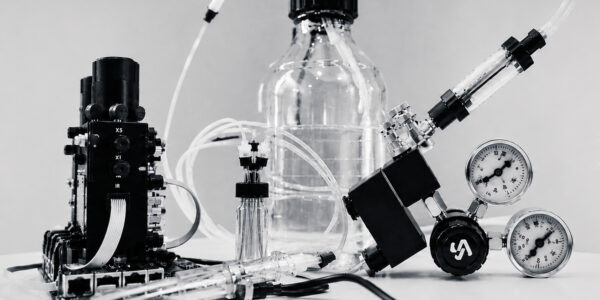

Cambridge has an incredible startup ecosystem where not only research spinouts, but also ideas sparked between two people, can grow into thriving companies. For Friederike and me, winning first prize at the 2025 Climate Challenge was a pivotal moment. It gave us the initial momentum to turn an early idea into something tangible, secure our first grants, develop our MVP and just over a year later, reaching an exciting milestone: raising £2.1 million to scale our technology towards pilot demonstration.
Deepanshu Singh
CEO & Co-founder, Neela Biotech
As a scientist, coming up with new ideas was never the challenge. The difficult part was knowing how to turn them into a startup. After 18 months of building Neela, I still believe the hardest step is going from zero to one. Cambridge offers plenty of talks and seminars on entrepreneurship and very powerful accelerator programmes which can provide sustained support over several months, answering the small questions, keeping you accountable, and giving you the motivation to push through challenges.
Friederike Nintzel
CTO & Co-founder, Neela Biotech
Neela Biotech is decarbonising aviation with a breakthrough Controlled Microbial Upcycling process that transforms waste into Sustainable Aviation Fuel (SAF).
Aviation currently accounts for around 8% of the UK’s emissions and is projected to become the country’s largest emitting sector by 2040, responsible for an estimated 27% of total emissions. While electrification may play a role in short-haul travel, it is not a viable solution for long-haul aviation. As a result, Sustainable Aviation Fuel (SAF) is widely regarded as the most practical pathway for decarbonising the sector. Yet existing SAF production routes remain energy-intensive, capital-heavy, and expensive, limiting SAF to less than 1% of global jet fuel supply.
Founded in 2025 by Dr Deepanshu Singh and Friederike Nintzel, Neela Biotech is addressing this challenge with a microbial alternative using it’s Controlled Microbial Upcycling (CMU) platform. By combining synthetic biology, artificial intelligence, and microbial fermentation, the company converts abundant waste feedstocks, including agricultural residues and food waste, into scalable and low cost SAF. The process requires significantly less energy than conventional production methods, avoids competition with food crops and agricultural land, and can be deployed using existing biogas and refinery infrastructure, reducing both costs and barriers to adoption.
Neela Biotech’s progress has been marked by a series of significant milestones. In 2025, the company won the Cambridge Zero Climate Challenge before being named top 8 global start-ups in ClimateLaunchpad amongst 3,000 on the international stage, highlighting the potential of its innovative approach to SAF production.
The same year, the company secured grant funding from the Henry Royce Institute to support a technoeconomic study with the Aviation Impact Accelerator at the Whittle Laboratory, and an Innovate UK grant to help accelerate the development and commercialisation of its technology.
Building on this momentum, the company secured £2.1m in pre-seed funding in 2026 to advance its pilot-scale trials. The investment represents a major step for Neela Biotech, enabling the company to accelerate its mission to deliver sustainable aviation fuel that is scalable, cost-competitive, and capable of delivering significant reductions in aviation emissions.
As the aviation sector faces growing pressure to reduce emissions, Neela Biotech is helping to unlock a new generation of sustainable aviation fuels. With strong technical progress, growing investor backing, and deep roots in Cambridge’s innovation ecosystem, the company is well positioned to play a significant role in the future of low-carbon aviation.
With rising global demand for SAFs and accelerating pressure on aviation to decarbonise, has meant that Neela Biotech is positioned to become a leading force in decarbonising aviation.

Published:
Neela Biotech data
- Support programmes accessed
- Infrastructure accessed
- Industry sector
- Energy and power
- Technology type
- Manufacturing